Accueil / Our analysis / Coubertin and the Olympics won’t save the suburbs, but Bikestormz will…
Coubertin and the Olympics won’t save the suburbs, but Bikestormz will…
July 2022. “So Good”, a magazine published by So Press, has put the vélorution [a combination of vélo (bike) and revolution] on its cover. We can only applaud them. In this complete dossier, the editors also discuss the #bikelife phenomenon and its social implications. We talked about it in this VISION analysis for the free access occasion originally published in April 2018. Stay ahead of the game: read Codezero. This summer, the agency will be taking a look back at its “strategic moments” in sport.
Political discourse regularly links sport and suburbia and often promises that the former could save the latter.
Since the awarding of the 2024 Olympic Games to the city of Paris, people have been talking about all sorts of scenarios. The Olympics will be an opportunity to get all the French into sport, to reconcile them with their health, and perhaps propel the country into the stratosphere. This ecumenical event would finally be the means to give meaning to the lives of those who live in disadvantaged areas.
Of course, sport, while not being a social lift that would work for the majority or a miracle solution for a broken integration, has many virtues. It socialises, it teaches us to live, to confront ourselves, it allows us to experience joy, success, and difficulty, and it allows us to consider ourselves, in the midst of and with others.
However, using sport in an attempt to solve problems that go far beyond the practice of sport itself is an illusion, especially by applying an elitist model that is therefore unsuitable for the greatest number. We will not save the suburbs by building stadiums when sport has gradually moved away from them. Moreover, in “standard” sport, there is only one winner, and the Olympic Games will only celebrate them. How can we teach young people who are already struggling to find their place in society that defeat and obscurity can also be the result of years of effort and sacrifice? How can we not channel their energy, their thirst for life and existence into a frame of reference that most of them have no use for.
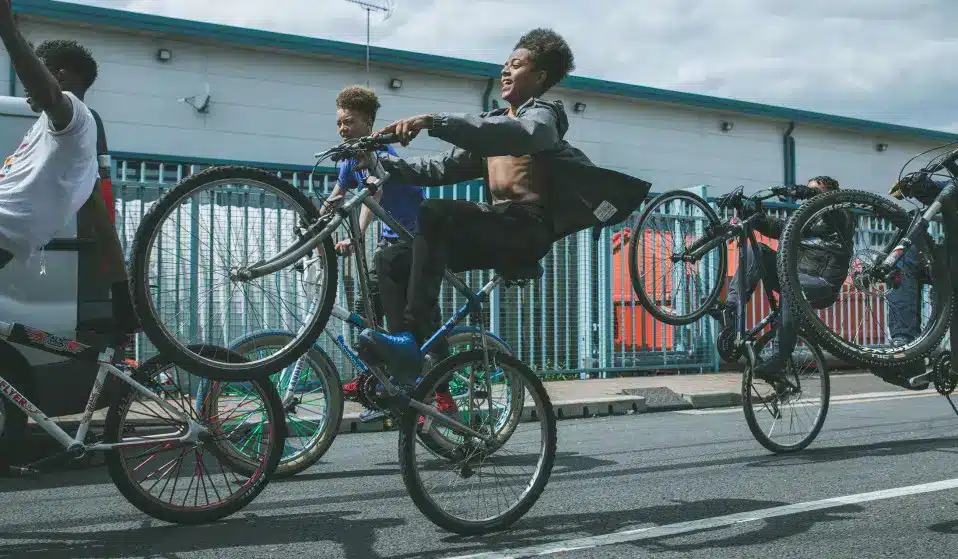
The Bikestormz phenomenon emerged in 2014, initiated by a young Londoner. What is it about? Hundreds of young urban cycling enthusiasts getting together to protest and act against violence.
Starting in London, the movement has spread throughout the country with the aim of uniting young people from poor neighbourhoods. Mac, the initiator, explains it himself: “The aim of Bikestormz is to unite young people and put an end to the wars between neighbourhoods.” Young people come together to create genuine unity, far from suburban strife. Their motto reads: “Drop the knives and get on your bike.” (source Redbull.com)
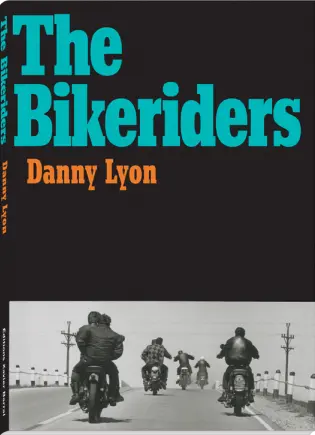
Bikestormz celebrates riding freely and pulling a wheelie where possible. On a bike, it’s a soft, acceptable version of wheeling on a motorcycle, but without the speed, noise and risk. The approach is the same: take the plunge, dare to transgress, stand out, assert yourself, break the rules, show off, be different. Who could blame a young person for these desires? With Bikestromz, they take over the city, symbolically invading and sharing it at the same time. The case is much less superficial and anodyne than it seems. Bikestormz riders are the heirs of other rebels on two wheels, the Bikeriders Bikeriders photographed by Danny Lion, they’re also close in spirit to Baltimore’s 12 O’clock Boys of Baltimore. The documentary went around the world. There are social roots to this movement, to ignore them would be wilful blindness.
Bikestormz is a social movement first, a cultural one in a way, a sporting one in fact, without the French cycling federation seeing an opportunity in it. Bikestormz is a soft, acceptable revolution, an opportunity. Bikestormz is a soft, acceptable revolution, an opportunity. Don’t be fooled, it has already been discussed by Arte. They proposed a peaceful movement, but their movement is no less serious. Their approach calls for “free” sport, without constraint, without structure, without hierarchy. Like skateboarding. Their discipline is closer to the search for the beautiful gesture than to any ranking. Like skateboarding. Like skateboarding. Their instrument, the bicycle, is both timeless and a vector of modernity in the age of neo-mobility. Ultimately, Bikestormz puts “sport” back into the heart of the city, it’s a topical theme.
Coubertin and the Olympic Games, as well as the artificial wave imagined in Sevran, will not save the suburbs. Sport will not solve human, economic and social problems that have been rooted for decades. We are, however, humble enough to think that “sport”, at least what the game can carry of free impetus, can be part of the solution. Bikestormz is an initiative that comes from the field, and that is a precious thing.